How Mobile Network Codes Work: A Practical Guide to MCC, MNC, and PLMN

October 24, 2026 · 32 reads
Introduction
Mobile networks rely on unique codes to identify countries, operators, and individual network services. These codes help telecom professionals understand how mobile networks connect and operate across different regions. Three important identifiers support this process: Mobile Country Code (MCC), Mobile Network Code (MNC), and Public Land Mobile Network (PLMN). Each identifier serves a different purpose, but they work together to describe a mobile network. Understanding these codes helps researchers compare operators, investigate roaming options, and review global telecom information. It also helps eSIM users learn more about the networks their devices may access. Although these terms can seem technical at first, their basic roles are easy to understand. This guide explains each code, shows how they relate, and highlights practical ways to use them when researching mobile networks.
Why Mobile Networks Need Unique Identifiers
Mobile devices connect to networks that operate in many countries and regions. Each operator needs a clear identity so devices and telecom systems can distinguish one network from another.
Network names alone cannot always provide enough detail. Different operators may use similar names, and one company may operate several networks. Numeric identifiers give telecom systems a more consistent way to recognize network identities.
These codes support several important activities:
- Identifying the country associated with a mobile network.
- Distinguishing one mobile operator from another.
- Organizing network information in telecom databases.
- Supporting network selection and roaming processes.
- Helping researchers compare mobile network records.
- Improving the clarity of technical documentation.
MCC, MNC, and PLMN form an important part of this identification system. Learning their differences makes telecom research easier and more accurate.
Understanding the Mobile Country Code (MCC)
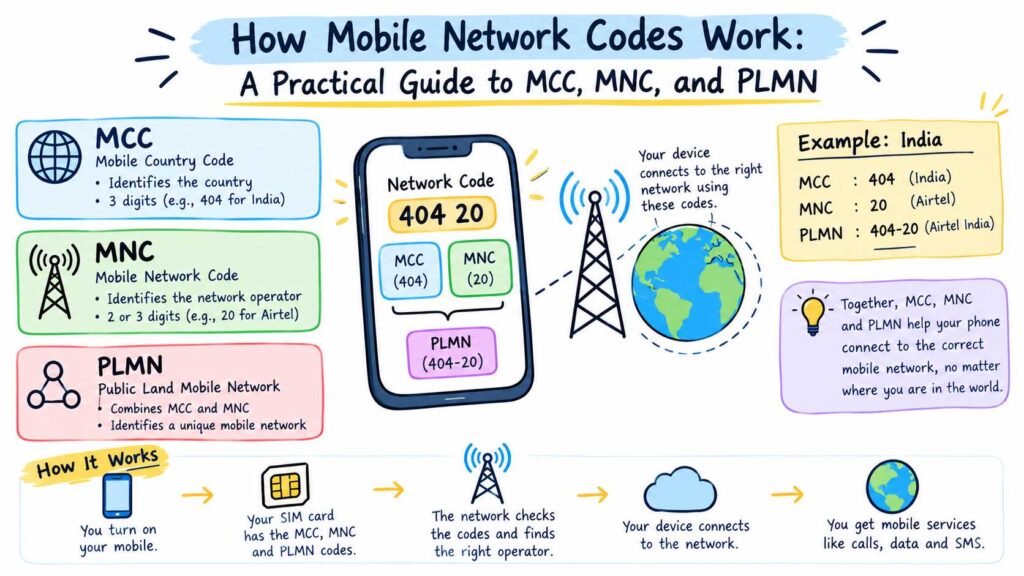
The Mobile Country Code, or MCC, identifies the country or geographic area associated with a mobile network assignment. It contains three digits and forms one part of a broader network identifier.
Telecom professionals use the MCC to organize network information by country or territory. It helps them distinguish network assignments associated with different geographic areas.
For example, a researcher comparing mobile operators in several countries can use MCC values to group records by their assigned country or area.
However, the MCC does not identify a specific operator on its own. Several operators may share the same MCC because they operate within the same country or assigned geographic area.
Where the MCC Helps
The MCC supports several telecom research activities:
- Country-level research: It helps researchers group network records by geographic assignment.
- Operator comparisons: It provides a starting point for comparing operators within the same country.
- Database organization: It helps teams structure network records consistently.
- Roaming research: It contributes to identifying the network a device encounters while travelling.
- Technical analysis: It helps professionals interpret mobile network identifiers.
Researchers should always check reliable records before assigning a country to an MCC. They should not assume that every code follows a simple geographic pattern.
Exploring the Mobile Network Code (MNC)
The Mobile Network Code, or MNC, helps distinguish mobile network operators or network assignments within an MCC context. Its length can vary by numbering plan, so researchers should preserve the format shown in reliable source records.
An MNC works with an MCC to provide more specific network identification. The MCC gives the country or geographic context, while the MNC helps distinguish the relevant network assignment.
For instance, several mobile operators may work within one country. Their network records can use different MNC values under the same MCC, depending on the applicable assignments.
Why MNC Records Need Careful Review
MNC information requires attention because formatting and assignment details can vary. Researchers should consider these points:
- Some numbering plans use two-digit MNCs, while others use three-digit MNCs.
- Leading zeros may matter when a source displays a code as a fixed-width identifier.
- One operator may have multiple network assignments.
- Ownership changes or network reorganizations may affect how records appear.
- Different databases may update their information at different times.
A researcher should not remove leading zeros or change an MNC’s length without checking the relevant numbering rules. Such changes can create incorrect matches between network records.
What Does PLMN Mean?
A Public Land Mobile Network, or PLMN, refers to a mobile network associated with a particular operator or network identity. In mobile network identification, the PLMN identity combines the MCC and MNC.
The MCC provides geographic context, and the MNC distinguishes the network assignment within that context. Together, they identify a PLMN.
This combined identity gives telecom systems a more precise way to recognize networks than either code can provide alone.
How PLMN Supports Network Identification
PLMN information plays a role in several mobile network processes:
- Network selection: Mobile devices use network information when identifying available networks and choosing among permitted options.
- Roaming: Network identities help devices and systems recognize visited networks.
- Network lists: Telecom databases use PLMN identities to organize operator information.
- Technical troubleshooting: Engineers can review network identifiers when investigating connection problems.
- Mobile service research: Analysts can compare network records across countries and operators.
A PLMN identity does not guarantee that a device can connect to a network. Access also depends on coverage, device compatibility, operator agreements, subscription rules, and other technical conditions.
MCC, MNC, and PLMN: Key Differences
These three terms describe related but distinct parts of mobile network identification.
| Identifier | Full name | Main role | Typical format |
|---|---|---|---|
| MCC | Mobile Country Code | Identifies a country or geographic assignment | Three digits |
| MNC | Mobile Network Code | Distinguishes a network assignment within an MCC context | Two or three digits, depending on the numbering plan |
| PLMN | Public Land Mobile Network | Combines MCC and MNC to identify a mobile network | MCC + MNC |
The main difference lies in how much information each identifier provides. An MCC offers geographic context, while an MNC adds network-level distinction. The PLMN combines both values into a more complete network identity.
Researchers should keep these roles separate when creating reports or comparing records. Confusing the identifiers can lead to incorrect conclusions about an operator or its network.
How These Identifiers Work Together
Consider a hypothetical network record with the following values:
- MCC: 123
- MNC: 45
- PLMN identity: 123-45
These example values illustrate the relationship between the identifiers. They do not represent a verified country or real mobile operator.
The MCC identifies the geographic assignment in the example. The MNC distinguishes the network assignment within that context. Together, both values form the PLMN identity.
A telecom researcher can use this relationship to organize the record and compare it with other network entries.
Real-world research requires more care than this simple example suggests. Researchers must confirm the actual code assignments, preserve the source format, and check whether the information reflects current records.
Practical Uses of Mobile Network Identifiers
MCC, MNC, and PLMN information supports several professional and technical activities.
Telecom Market Research
Researchers use network identifiers to organize operator information across different countries. These codes help them compare network assignments and maintain consistent datasets.
Roaming Analysis
Roaming research often involves checking which networks operate in a destination country. PLMN information helps analysts identify networks, while separate roaming agreements and service conditions determine whether a subscriber can use them.
Mobile Network Troubleshooting
Technical teams may review network identifiers when investigating registration failures or unexpected network selection. They can compare device logs with trusted network records to identify possible mismatches.
These codes provide useful clues, but they do not explain every connection problem. Signal strength, device settings, SIM or eSIM configuration, and network restrictions may also affect service.
eSIM Research
An eSIM lets a compatible device download and manage a mobile subscription without using a removable physical SIM card. The service still relies on mobile networks and their identifiers.
People researching eSIM services can use MCC, MNC, and PLMN information to understand network assignments associated with different destinations or operators. However, an identifier alone cannot confirm an eSIM plan’s coverage, price, speed, or availability.
Telecom Database Management
Businesses that maintain operator directories need consistent records. Network identifiers help them organize entries, compare sources, and reduce confusion between similar operator names.
A Reliable Method for Checking Network Records
Accurate research starts with clear source information. Follow a consistent process whenever you investigate mobile network identifiers.
Start With the Exact Code
Record the MCC, MNC, or PLMN value exactly as the source displays it. Keep leading zeros and other formatting details until you confirm the applicable numbering rules.
Identify the Correct Operator or Region
Use the MCC and MNC together when researching a network assignment. Avoid identifying an operator from an MNC alone because the code needs its proper context.
Compare Multiple Records
Check whether trusted sources agree on the code, operator name, and geographic assignment. If two records differ, investigate their publication dates and scope before choosing one.
Check the Update Date
Telecom records can change as operators merge, reorganize, or receive new assignments. A recent source may provide better context, but researchers should also consider the source’s authority and accuracy.
Record Any Uncertainty
If a code does not match the expected operator, do not change it just to fit your assumptions. Mark the discrepancy and investigate it further.
A careful process helps researchers create useful records without making unsupported claims.
Common Mistakes to Avoid
Even experienced researchers can misinterpret mobile network identifiers when they overlook small details.
Treating MCC as an operator code: MCC identifies the country or geographic assignment, not one specific operator.
Using MNC without context: An MNC needs the correct MCC and numbering plan for reliable interpretation.
Assuming every MNC has the same length: MNCs may contain two or three digits, depending on the applicable assignment.
Removing leading zeros: Changing a code’s displayed format can cause matching errors.
Treating PLMN as a coverage guarantee: A PLMN identifies a network, but it does not prove that a particular service or device can access it.
Trusting outdated records: Old entries may not reflect current network assignments or operator changes.
Confusing operator ownership with network identity: A company can manage several network identities, and network assignments may change over time.
Researchers can avoid many of these problems by checking source dates, preserving code formats, and confirming assignments through reliable records.
What eSIM Users Should Know About Network Codes
eSIM technology makes it easier to activate mobile plans on compatible devices. However, users still need to understand the difference between a network identity and the service a plan provides.
An eSIM plan may support one or more partner networks in a destination. The available networks can depend on the provider’s agreements, local coverage, device compatibility, and plan conditions.
MCC, MNC, and PLMN information can help users and researchers investigate the networks associated with a service. Still, users should check the provider’s coverage details before purchasing a plan.
For example, a network identifier may show which operator a record represents. It cannot tell users whether their chosen plan includes enough data, supports calls, or offers service in a specific location.
The most useful approach combines network identification with current plan details and official coverage information.
How eSIMGlobo.com Supports Telecom Research
Finding consistent mobile network information can take time, especially when research covers several countries and operators. A well-organized telecom directory can make the process easier by helping researchers explore operator information and network identifiers in one place.
eSIMGlobo.com focuses on global telecom directory information, including mobile network operators and MCC, MNC, and PLMN identifiers. This type of resource can help telecom researchers, developers, analysts, and eSIM users understand network records more clearly.
When using any directory, compare important details with suitable authoritative sources. Check update dates, confirm the context of each identifier, and avoid treating a directory entry as proof of service availability.
Combining a structured directory with careful verification helps users build a clearer picture of mobile network assignments around the world.
Frequently Asked Questions
What is an MCC in mobile networks?
An MCC is a three-digit Mobile Country Code. It identifies the country or geographic area associated with a mobile network assignment.
What does an MNC identify?
An MNC is a Mobile Network Code. It helps distinguish a network assignment within the context of its MCC.
What is a PLMN identity?
A PLMN identity combines an MCC and an MNC. This combination provides a more specific identity for a mobile network.
Are MCC and MNC the same?
No. The MCC identifies the geographic context, while the MNC distinguishes the network assignment within that context.
How many digits does an MNC contain?
An MNC can contain two or three digits, depending on the applicable numbering plan. Researchers should preserve the source format and check the relevant assignment rules.
Why do telecom researchers use PLMN identifiers?
Researchers use PLMN identifiers to organize network records, compare operator information, and investigate mobile network selection or roaming behavior.
Can an MCC identify a specific mobile operator?
No. Multiple operators may share an MCC. Researchers generally need the MNC as well to identify the relevant network assignment.
Do network identifiers guarantee roaming access?
No. Identifiers help systems recognize networks, but roaming access also depends on agreements, subscriptions, device support, coverage, and operator policies.
Can eSIM users benefit from MCC and MNC information?
Yes. These identifiers can help users research network assignments connected with eSIM services. However, users should also review the plan’s coverage, supported services, and restrictions.
How can I verify a mobile network identifier?
Start with the exact code, check its format, and compare it with reliable and current telecom records. If sources disagree, investigate the differences before using the information.
Final Thoughts
Mobile network identifiers provide a foundation for understanding how telecom systems distinguish countries, operators, and networks. The MCC supplies geographic context, the MNC adds network-level distinction, and the PLMN brings both values together.
These identifiers support telecom research, roaming analysis, network troubleshooting, and eSIM investigations. However, researchers must interpret them carefully and verify important details before drawing conclusions.
By preserving code formats, checking reliable records, and understanding each identifier’s role, readers can research global mobile networks with greater confidence.
Leave a Reply