IVF and Fertility Treatment Guide: From First Tests to Choosing a Clinic

October 6, 2026 · 14 reads
Introduction
Fertility treatment can involve many steps. People often research IVF, fertility tests, clinic costs, success rates, and other treatment choices.
Each person may have different medical needs. Clinics may also offer different services and use different ways to report results.
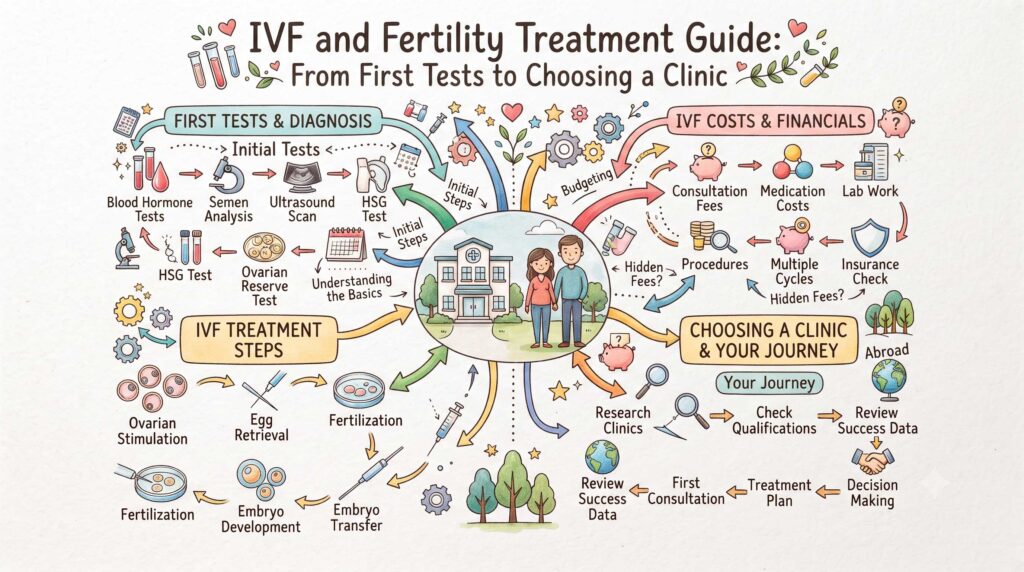
Learning the basics can help you ask better questions. It can also help you compare fertility care more clearly. This guide explains the main areas to research before making treatment decisions.
Begin With Fertility Testing
Doctors may start fertility care with a health review and fertility tests. These tests can provide information about possible fertility factors.
The testing plan can vary from person to person. Doctors may consider medical history, previous treatment, age, and other findings.
Common fertility assessments can include:
- Blood tests
- Hormone tests
- Ultrasound scans
- Semen analysis
- Ovarian reserve tests
- Tubal checks
- Other tests based on medical findings
No single test can explain every fertility concern. Several factors can affect fertility. A fertility specialist can review your results and explain them.
What Happens During IVF?
IVF means in vitro fertilization. Doctors use laboratory treatment to help fertilize an egg with sperm.
A typical IVF process can include several stages.
Fertility Assessment
The clinic reviews your health history and fertility information. The doctor may also review previous tests and treatments.
Ovarian Stimulation
Fertility medicines can help the ovaries develop several eggs. Doctors monitor the response through scans and blood tests.
Egg Retrieval
Doctors collect mature eggs during a medical procedure. The laboratory then prepares the eggs.
Fertilization
The laboratory combines eggs and sperm. The clinic may use standard IVF or ICSI.
Embryo Development
The laboratory monitors embryo growth. The team may assess embryo development before transfer.
Embryo Transfer
A doctor places an embryo into the uterus. The clinic then provides follow-up instructions.
Pregnancy Testing
The clinic may schedule a pregnancy test after transfer. The timing can vary between treatment plans.
Doctors can adjust treatment based on medical findings. Each cycle may follow a different path.
Understanding IVF Treatment Costs
IVF costs can vary between clinics and patients. The final amount depends on the services included.
Some clinics use package prices. Others charge separate fees for different services.
| Cost Area | Possible Charges |
|---|---|
| Consultation | Specialist visits and treatment planning |
| Testing | Blood tests, scans, and fertility assessments |
| Medicines | Fertility medicines and related drugs |
| Egg retrieval | Procedure and clinical care |
| Laboratory services | Fertilization and embryo development |
| Embryo transfer | Transfer procedure |
| ICSI | Additional laboratory treatment |
| Genetic testing | Testing when selected or recommended |
| Embryo storage | Storage and related fees |
| Follow-up | Later visits and tests |
Ask the clinic for a detailed cost estimate. Check which services the estimate includes.
Costs That May Come Later
The first IVF quote may not show the full treatment cost. Medicines can create separate charges.
Additional testing may also add expenses. ICSI or genetic testing can create extra laboratory costs.
Embryo storage may create longer-term fees. Follow-up visits may also add to the total.
Travel creates more expenses when you seek treatment away from home. These costs may include flights, accommodation, and local transport.
Ask about possible extra costs before comparing clinics.
Understanding IVF Success Rates
Success rates can help you research fertility clinics. However, you should not compare percentages without checking their details.
Clinics may report different outcomes. Some may report pregnancy rates. Others may report live birth rates.
Patient groups can also differ. Age, diagnosis, treatment type, embryo type, and donor treatment can affect outcomes.
Review these points when you compare results:
- Patient age
- Diagnosis
- Treatment type
- Fresh or frozen transfer
- Donor or non-donor treatment
- Pregnancy or live birth outcome
- Per-cycle results
- Cumulative results
- Reporting year
- Number of cycles
The definition behind a number matters. Always check how the clinic calculated the result.
Research More Than the Clinic Name
A clinic search should cover the full care process. One success number cannot show everything about a provider.
Review treatment choices and fertility tests. Look at laboratory and embryology services. Also check how the clinic explains prices and results.
Useful research points include:
- Fertility specialists
- Fertility testing
- IVF services
- ICSI services
- Laboratory facilities
- Embryology services
- Egg storage
- Embryo storage
- Follow-up care
- Patient communication
Clear information can make clinic research easier.
Compare Clinics With a Simple Checklist
Use the same questions for each clinic. This can make your comparison more organized.
| Category | What to Check |
|---|---|
| Testing | What fertility tests are available? |
| IVF | What IVF services does the clinic offer? |
| ICSI | Is ICSI available? |
| Laboratory | What laboratory services are available? |
| Storage | What egg and embryo storage options exist? |
| Cost | What does the quoted price include? |
| Success data | How does the clinic report results? |
| Follow-up | What care follows treatment? |
| Communication | How does the clinic answer questions? |
| Travel | What information does it provide for visiting patients? |
Use this table to organize information. It does not rank clinics or doctors.
IVF Treatment Abroad
Some people research fertility treatment in other countries. Overseas treatment needs careful planning.
Fertility laws can differ between countries. Rules may cover donor eggs, donor sperm, embryos, genetic testing, and embryo storage.
Eligibility rules may also vary. Some countries have specific rules for age or partnerships. Surrogacy laws can differ too.
Travel creates extra needs. You may need accommodation, local transport, and follow-up care.
Check current official rules before making overseas treatment plans. Discuss legal questions with qualified professionals.
Comparing IVF Costs by Country
Country comparisons can become difficult when clinics include different services. One clinic may include laboratory work. Another may charge it separately.
Compare the full cost instead of one advertised price.
Review:
- IVF treatment
- Fertility medicines
- Fertility testing
- ICSI
- Genetic testing
- Donor services
- Embryo storage
- Follow-up care
- Flights
- Accommodation
- Local transport
A lower advertised price does not always mean a lower total cost.
Egg Freezing: Important Basics
Egg freezing allows a person to store eggs for possible future use. Doctors usually use medicines before egg retrieval.
Doctors collect mature eggs during a medical procedure. The laboratory then freezes suitable eggs.
Egg freezing does not guarantee future pregnancy. Age at the time of freezing can affect future outcomes.
Ask about storage periods and fees. Also ask about future treatment costs.
ICSI and IVF: What Is the Difference?
ICSI means intracytoplasmic sperm injection. A laboratory specialist places one sperm directly into an egg.
Doctors may consider ICSI in certain fertility situations. Male-factor fertility concerns can influence this decision. Previous fertilization problems may also matter.
ICSI does not guarantee pregnancy. A fertility specialist can explain its possible role in treatment.
Other Fertility Treatment Options
IVF is one of several fertility treatment options. Other approaches may suit some patients.
| Treatment | Basic Role |
|---|---|
| Fertility medicines | May support ovulation in selected cases |
| IUI | Places prepared sperm into the uterus |
| IVF | Fertilizes eggs in a laboratory |
| ICSI | Places one sperm directly into an egg |
| Egg freezing | Stores eggs for possible future use |
| Embryo freezing | Stores suitable embryos |
| Donor treatment | Uses donor eggs or sperm |
| Fertility surgery | Addresses selected physical problems |
The best option depends on individual medical factors. A fertility specialist can explain the choices.
Questions to Ask a Fertility Clinic
A question list can help you prepare for your appointment.
You may ask:
- Which fertility tests do I need?
- What treatment options can I discuss?
- What does the IVF price include?
- Which medicines cost extra?
- Are laboratory fees included?
- How does the clinic measure success?
- Which patient group does the data cover?
- What follow-up care do you provide?
- What storage fees apply?
- What extra costs should I expect?
Ask the clinic to explain any unclear term or result.
Mistakes to Avoid During Fertility Research
Fertility research can become confusing when people focus on one claim. A success rate needs context.
Cost comparisons also need care. One clinic may include services that another clinic charges separately.
Old information can create another problem. Clinic services, prices, policies, and laws can change.
Try to avoid:
- Choosing only by price
- Comparing unrelated success rates
- Ignoring medicine costs
- Overlooking storage fees
- Using outdated information
- Treating reviews as medical evidence
- Assuming every IVF cycle follows one process
- Ignoring overseas legal requirements
Use several reliable sources when researching fertility care.
A Practical Fertility Research Method
A simple process can keep your research organized.
Step 1: Learn
Understand IVF, ICSI, IUI, egg freezing, and fertility testing.
Step 2: Prepare
Write down your questions before meeting a specialist.
Step 3: Compare
Review clinics using the same factors.
Step 4: Check Costs
Ask for detailed estimates and extra charges.
Step 5: Review Results
Check how each clinic defines and reports success.
Step 6: Verify Rules
Check current laws if you consider treatment abroad.
Step 7: Discuss
Take your research to a qualified fertility specialist.
Four Simple Research Examples
Comparing Success Rates
Two clinics may publish different success percentages. One may report pregnancy rates. Another may report live birth rates.
Check the definitions first. The numbers may not offer a fair comparison.
Checking a Treatment Quote
A clinic may advertise one IVF package price. The quote may not include medicines or storage.
Ask for a complete cost breakdown. This gives you a clearer view of the possible expense.
Researching IVF Abroad
An overseas clinic may offer many fertility services. Its website may not explain every local fertility rule.
Check official sources before making plans. Ask the clinic about current requirements.
Planning for Egg Freezing
A clinic may show an initial egg-freezing price. It may not mention storage or later treatment costs.
Ask about both areas. This can help you understand the longer-term cost.
How IVFHospitalsNow.com Can Help
IVFHospitalsNow.com focuses on fertility education, research, and provider discovery. The platform can help users learn about fertility treatment options.
It can also support clinic research. Users can explore IVF, ICSI, egg freezing, fertility testing, costs, and success rates.
The platform does not replace medical advice. Qualified fertility specialists should guide personal treatment decisions.
Use educational resources to prepare useful questions. Then discuss those questions with your specialist.
Frequently Asked Questions
1. What is IVF?
IVF means in vitro fertilization. Doctors collect eggs and sperm for laboratory fertilization. The clinic may later transfer an embryo into the uterus. The exact process can vary between patients.
2. Why do doctors perform fertility tests?
Fertility tests can provide information about possible fertility factors. Doctors may use blood tests, scans, semen analysis, and other assessments. The exact testing plan depends on medical history and individual findings.
3. What are the main IVF stages?
An IVF cycle may include fertility assessment, ovarian stimulation, egg retrieval, fertilization, embryo development, embryo transfer, and pregnancy testing. Doctors may adjust the process based on medical findings.
4. What affects IVF treatment costs?
Medicines, testing, laboratory services, ICSI, genetic testing, storage, and follow-up care can affect the total. Travel can add more expenses. Ask the clinic for a detailed estimate.
5. Why do IVF success rates vary?
Clinics may treat different patient groups. They may also use different outcome measures. Age, diagnosis, treatment type, embryo type, and donor treatment can affect results.
6. How can I compare fertility clinics?
Review treatments, testing, laboratory services, costs, success data, storage, follow-up care, and communication. Use the same comparison points for every clinic.
7. What is ICSI?
ICSI means intracytoplasmic sperm injection. A laboratory specialist places one sperm directly into an egg. Doctors may consider it in certain fertility situations.
8. Does egg freezing guarantee a future pregnancy?
No. Egg freezing does not guarantee future pregnancy. Several factors can affect future outcomes. Age at the time of freezing can also matter.
9. What should I include when comparing IVF costs abroad?
Compare treatment, medicines, testing, ICSI, genetic testing, donor services, storage, follow-up care, travel, and accommodation. Different clinics may include different services.
10. What should I check before choosing IVF abroad?
Check current laws and clinic requirements. Review donor treatment, embryo rules, genetic testing, storage, eligibility, and other relevant rules. Also plan travel and follow-up care.
11. What are the main fertility treatments besides IVF?
Options may include fertility medicines, IUI, ICSI, egg freezing, embryo freezing, donor treatment, and selected fertility surgery. A specialist can explain the available choices.
12. Can online fertility information replace medical advice?
No. Online information can explain general fertility topics. It cannot assess your personal medical needs. A qualified fertility specialist can discuss your health and treatment choices.
Final Thoughts
Fertility care covers many important topics. IVF includes testing, medicines, laboratory work, procedures, and follow-up. Cost and success data also need careful review.
Start with the basics. Learn about fertility testing and treatment choices. Then compare clinics using the same questions and factors.
Take extra care with overseas treatment. Check current laws, clinic requirements, and total costs. Use reliable information to prepare for a discussion with a qualified fertility specialist.
Leave a Reply