DevOps Training in Japan: Skills, Tools, and Support for Modern IT Teams

September 29, 2026 · 24 reads
Introduction
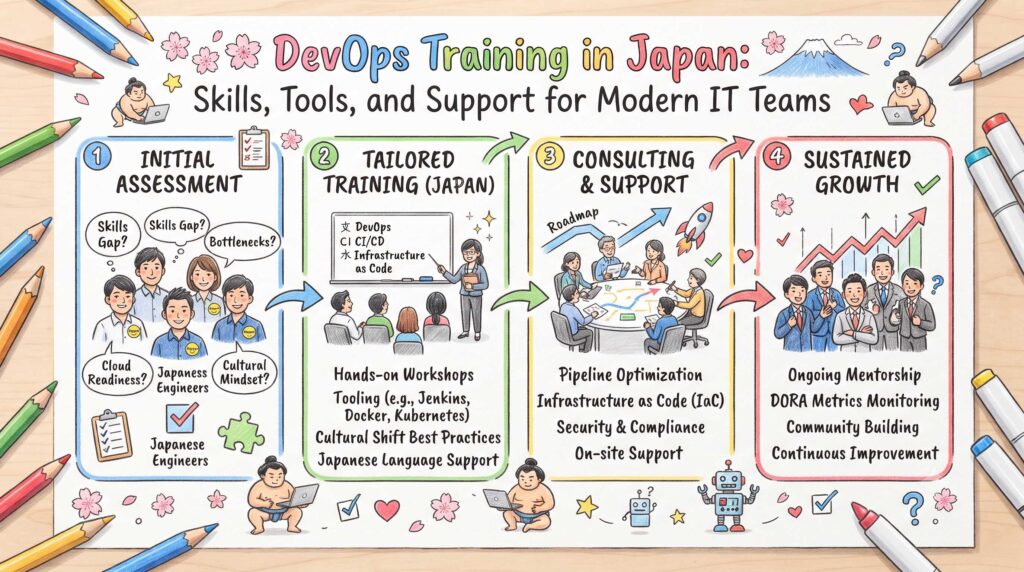
A software team handles many jobs before an update reaches users. Developers write code. Testers check it. Operations teams run the system. Security teams look for risks. Cloud teams manage servers and networks. When each group works alone, small delays can grow. Manual work can add more errors. DevOps gives these teams a shared way to work. It brings code, testing, release work, and system care closer together. DevOps 研修 means DevOps training in Japanese. It teaches the skills teams need for this kind of work. Common topics include cloud, automation, testing, CI/CD, and monitoring. Teams can also learn Kubernetes, Terraform, SRE, security, and MLOps. DevOpsSchool.jp supports technology learning and technical work in Japan. Its services cover training, consulting, implementation help, freelancers, and technical support. Companies can use these services based on their own needs. A team does not need to change everything at once. One useful skill can make a good starting point.
The Main Idea Behind DevOps Training
DevOps training helps people understand the full software process. A developer may focus on code. An operations engineer may focus on running systems. DevOps connects these two sides. The team learns how one change can affect the whole process.
A basic course may teach source control, testing, automation, cloud tools, CI/CD, and monitoring. Source control keeps track of code changes. Automation lets tools handle repeated jobs. Testing checks software before release. CI/CD helps teams build and release small changes. Monitoring shows what happens inside a system.
DevOps 研修 should include practical work. Learners need more than tool names and short definitions. They should create a small setup and work with it. They can run tests, make changes, check results, and fix errors. This gives them a better feel for the work.
Companies should also match training with team skill levels. Beginners need simple lessons and clear tasks. Skilled engineers may need deeper labs. Managers may need process knowledge instead of detailed commands. The right course should fit the people who will use it.
What DevOpsSchool.jp Offers
DevOpsSchool.jp focuses on technology training and support for teams in Japan. Its main areas include DevOps, SRE, DevSecOps, MLOps, cloud, automation, and software delivery.
The platform also covers consulting, implementation help, freelancers, and technical support. These services can help at different points in an IT project.
A company may need DevOps training for its engineers. Another company may need help with a cloud project. A third team may need support with monitoring or automation. A company may also need skilled technical workers for a short project.
Training helps people learn. Consulting helps teams work through a defined problem. Implementation help supports the move from a plan to working systems. Technical support helps teams handle issues after setup.
DevOpsSchool.jp can fit into these different needs. Companies should still define their own goals first. That makes it easier to choose the right service.
Why DevOps Skills Matter to Japanese Companies
IT teams often repeat the same tasks. An engineer may prepare every release by hand. Another worker may check the same settings each day. Someone may copy files from one system to another. These tasks take time and can cause mistakes.
A slow release can delay a useful update. A missed error can affect users. A system problem can also take longer to fix when teams lack shared processes.
DevOps practices can reduce some of this work. Automation can handle repeat tasks. Tests can check changes before release. Monitoring can show system health. Small releases can make changes easier to review.
Companies can also train several workers together. DevOps corporate training Japan can help teams build common skills. Developers, operations staff, security teams, and managers can learn how their work connects.
Training does not replace good planning. Teams also need time to use new skills. Small work tasks after training can help people turn lessons into daily habits.
Six Training Paths Worth Knowing
DevOps covers more than one tool or job. Different teams may need different skills. The table below shows six common training areas.
| Training Area | Simple Meaning | Useful For |
|---|---|---|
| DevOps 研修 | Learn better software delivery | DevOps teams |
| Kubernetes 研修 | Learn to run containers | Cloud teams |
| Terraform 研修 | Manage infrastructure with code | Infrastructure teams |
| SRE 研修 | Keep services reliable | Operations teams |
| DevSecOps 研修 | Add security to software work | Security teams |
| MLOps 研修 | Manage machine learning systems | ML teams |
These areas can also work together. A cloud team may use Kubernetes with Terraform. An operations team may combine SRE with DevOps tools. A security team may add DevSecOps checks to CI/CD. An ML team may use MLOps with cloud and automation tools.
The best starting point depends on the problem. A team with manual cloud work may need Terraform. A team with container workloads may need Kubernetes. A team with frequent outages may need SRE.
Kubernetes 研修: Learning Container Management
Kubernetes helps teams run containers. A container packages an app with the files it needs. Teams can move the same package between systems.
Kubernetes helps manage many containers. It can start them, stop them, and replace failed ones. It can also help send users to the right app instance.
Kubernetes 研修 should begin with basic parts. Learners can study pods, deployments, services, storage, and security.
A pod is a small unit that runs an app. A deployment controls how an app runs. A service gives other systems a way to reach the app. Storage keeps data that an app needs.
These terms can seem hard when learners only read about them. A lab can make each part easier to understand. Learners can deploy an app and change its version. They can also test what happens when one part fails.
Teams should use examples close to their own work. This helps learners connect the class with daily tasks.
Terraform 研修: Managing Infrastructure with Code
Terraform helps teams manage infrastructure through code. Infrastructure includes servers, networks, storage, and cloud resources.
Without Terraform, engineers may create each resource by hand. That process can take time. It can also create different setups across systems.
Terraform uses code files to describe the desired setup. Teams can review these files before making changes. They can also use the same setup more than once.
This method has a name: Infrastructure as Code. It means teams keep infrastructure settings in code.
Terraform 研修 can cover providers, resources, variables, modules, and state. A provider connects Terraform with another service. A resource describes something the team wants to create. Variables hold values that can change. Modules group settings that teams can reuse. State tracks resources that Terraform manages.
Hands-on work matters here. Learners can create a small cloud setup. They can review a change, apply it, and remove the resources. This gives them practice with the complete process.
SRE 研修 and DevSecOps 研修
SRE stands for Site Reliability Engineering. It helps teams keep services dependable. A dependable service should work when users need it.
SRE 研修 can cover monitoring, alerts, incidents, and service goals. Monitoring shows system health. Alerts tell teams when something needs attention. An incident means a problem affects a service.
Learners can also study how teams respond to incidents. They can look at what caused a problem. They can then find ways to reduce repeat issues.
DevSecOps adds security to normal software work. Teams check security during development and release work. They do not need to wait until the end.
DevSecOps 研修 can cover code checks, access rules, secrets, and safer releases. Developers can learn simple security checks. Operations staff can learn safe system practices. Security teams can set rules and review results.
SRE focuses on reliability. DevSecOps focuses on security. Both can work with DevOps.
MLOps 研修: Supporting Machine Learning Systems
MLOps brings DevOps ideas into machine learning work. Machine learning systems need code, data, and models.
A model learns patterns from data. It uses those patterns to make predictions. New data can change how the model performs.
MLOps 研修 can teach teams how to manage this work. Topics may include data checks, model tests, releases, version tracking, and monitoring.
A model can work well during testing and change later. User behavior can change. New data can change too. Monitoring helps teams spot these changes.
MLOps also helps teams repeat model training. It can connect data work with development and operations. This creates a clearer process for moving models into use.
Teams do not need to start with a large project. One model can provide a useful starting point. The team can learn what works before adding more processes.
Practical Situations Teams May Face
- A team spends hours on releases: Engineers prepare every release by hand. DevOps training can show them how to build a simple CI/CD process. The team can test changes before release.
- A cloud team creates resources by hand: Engineers set up servers one at a time. Terraform training can show them how to keep infrastructure settings in code. The team can review changes before applying them.
- An operations team gets too many alerts: Workers receive alerts all day. Important alerts can get lost. SRE training can help the team create alerts that need real action.
- Security checks happen too late: A security team finds problems near release time. DevSecOps training can move simple checks into development. Developers can then fix common issues earlier.
These examples show why hands-on learning matters. People learn more when they work on tasks that resemble their real jobs.
Companies can also track simple results. They might measure release time, manual tasks, errors, or system issues. These numbers can help teams see what changed after training.
DevOps Consulting and Technical Support in Japan
Training and consulting do different jobs. Training helps people gain skills. Consulting helps a team solve a specific problem.
DevOps コンサルティング may cover cloud systems, automation, testing, monitoring, or software releases. A consultant can review the current setup. The consultant can then help the team decide what to change.
A DevOps consultant Japan service may support a cloud migration. It may also help a company move an app into containers. Another team may need help with its release process.
DevOps support Japan focuses more on ongoing technical help. Support may include troubleshooting, system setup, cloud work, automation, monitoring, or technical reviews.
DevOpsSchool.jp includes training, consulting, implementation help, freelancers, and technical support. Companies can choose based on the work they need to complete.
A skill gap may call for training. A system design issue may need consulting. A continuing technical problem may need support.
Common Mistakes When Choosing DevOps Training
- Looking only at price: A cheap course may lack useful practice. Check the lessons, labs, and tools first.
- Choosing theory without labs: Reading cannot replace tool practice. Pick a course that lets learners use the tools.
- Trying to learn every tool: Too many tools can slow beginners down. Start with tools that solve a real team problem.
- Leaving out security: DevOps work still needs secure access and code checks. Check the security topics before joining.
- Ignoring reliability: Fast releases mean little when systems fail often. Look for monitoring and incident topics.
- Using outdated examples: Old examples may not fit your systems. Ask which tools and methods the course uses.
- Training one person for a team problem: One learner cannot always change a shared process. Consider group training when many roles share the work.
- Ending learning after class: People forget skills without practice. Give learners small tasks after training.
- Starting without a goal: A broad course may not solve the real issue. Define the problem before choosing.
- Expecting training to fix every problem: Training builds skills. Teams may still need tool or process changes.
A Simple Way to Pick the Right Course
Start with the problem, not the tool. Write down what slows the team down. Then decide what learners should be able to do after training.
Check the course goals. Look at the lab work. Review the tools. Check security and reliability topics. Think about the people who will attend.
A developer may need detailed tool work. A manager may need a wider view of the process. An operations engineer may need deeper work on monitoring and systems.
Ask about help after the course. Find out how learners can continue practicing. Also check whether the course fits the company’s current systems.
| Check Before Training | Why It Matters |
|---|---|
| Course goals | Keeps learning focused |
| Hands-on labs | Builds practical skills |
| Tools covered | Matches daily work |
| Security lessons | Helps find risks |
| Reliability lessons | Helps keep systems stable |
| Team training | Builds shared knowledge |
| Post-training support | Helps after class |
| Business needs | Links learning to real work |
The course should match the team’s skill level. Beginners need clear steps. Skilled engineers need useful challenges. Both groups need time to practice.
Where DevOpsSchool.jp Can Fit
DevOpsSchool.jp focuses on technology training and support for Japanese teams. Its areas include DevOps, SRE, DevSecOps, MLOps, cloud, automation, and modern software delivery.
A company can begin with DevOps 研修. A cloud team may need Kubernetes 研修 or Terraform 研修. An operations group may need SRE 研修. A security team may need DevSecOps 研修. A machine learning team may need MLOps 研修.
Training may not cover every project need. Some teams need help while changing systems. Others need a consultant to review their current setup. Some companies may need implementation help or ongoing technical support.
DevOpsSchool.jp offers services across these areas. Companies should still define their own needs before choosing a service. A clear problem gives the team a better starting point.
The target platform is DevOpsSchool.jp. Companies can review its current services and decide which option fits their work.
Frequently Asked Questions
1. What does DevOps 研修 teach?
DevOps 研修 teaches skills for building and running software. Courses may cover automation, testing, cloud, CI/CD, and monitoring. Learners should also get time to practice. Beginners can start with basic tools and simple tasks. Experienced engineers may need deeper labs. Companies should check the course content before choosing. The lessons should match the skills the team needs.
2. What does DevOps corporate training Japan mean?
DevOps corporate training Japan means DevOps training for company teams. Several employees can learn the same methods together. The course can focus on tools used by the company. Teams can also work on shared tasks during training. This can help different roles understand the same process. Companies should set clear goals before the course. They should also plan practice work afterward.
3. What can learners study in Kubernetes 研修?
Kubernetes 研修 can teach teams how to manage container-based apps. Common topics include pods, deployments, services, storage, and security. Learners can deploy an app and change its version. They can also test simple failures. Hands-on labs help make the concepts easier to understand. Beginners should choose clear lessons. Experienced users can choose deeper topics that match their work.
4. Why do teams choose Terraform 研修?
Terraform 研修 teaches teams how to manage infrastructure with code. Teams can use it for servers, networks, storage, and cloud resources. Learners can study providers, resources, variables, modules, and state. They can also practice reviewing changes before applying them. This approach helps teams repeat infrastructure setups. It also gives teams code they can review and track.
5. What skills does SRE 研修 cover?
SRE 研修 focuses on reliable services. It may cover monitoring, alerts, incidents, and service goals. Learners study how to find system problems and respond to them. They can also learn ways to reduce repeated manual work. Practical examples help connect these ideas to real systems. Companies should choose training that matches their services. Learners should then use the skills at work.
6. What happens in DevSecOps 研修?
DevSecOps 研修 teaches teams to include security during software work. Lessons may cover code checks, access rules, secrets, and safer releases. Teams can find common risks before users see them. Developers can learn basic security checks. Operations staff can learn safe system practices. Security teams can guide rules and reviews. This makes security part of normal software work.
7. Who should consider MLOps 研修?
MLOps 研修 can help teams that build or run machine learning systems. These teams manage data, models, code, tests, releases, and monitoring. New data can change model results. Teams need ways to track and test these changes. MLOps training can teach repeatable model work. It can also connect machine learning with DevOps tools. Teams can begin with one model and one clear goal.
8. What does DevOps コンサルティング include?
DevOps コンサルティング gives expert help with a DevOps problem. A consultant may review cloud systems, automation, testing, monitoring, or releases. The consultant looks at the current setup first. Then the consultant can help plan changes. This differs from training because the work focuses on a specific problem. Companies should explain the problem clearly before the consulting work starts.
9. What can a DevOps consultant Japan help with?
A DevOps consultant Japan service can help with cloud and software delivery work. The work may include automation, monitoring, process reviews, cloud changes, or tool choices. Some teams may need a short review. Others may need help during a larger project. Companies should ask about the exact work. They should also agree on goals, timing, and expected results.
10. What does DevOps support Japan cover?
DevOps support Japan can provide technical help after training or project work. Support may include troubleshooting, setup, automation, cloud tasks, monitoring, or system reviews. The exact work depends on the service. Some teams need help with one issue. Others need regular support. Companies should check the support scope before choosing. They should also ask about response times and technical skills.
11. How can a company compare DevOps training courses?
Start with the team’s main skill gap. Check course goals, lab work, tools, security, and reliability topics. Consider the skill level of each learner. Ask how much time learners spend practicing. Check what support the provider offers after class. A course should connect with real work. It should also give people enough time to use the tools. Clear goals make course choices easier.
12. How can a company begin DevOps training in Japan?
Pick one clear business or technical problem first. List the skills needed to solve it. Then find training that covers those skills. A cloud team may start with Terraform. A container team may start with Kubernetes. An operations team may start with SRE. Give learners small tasks after training. Review the results. Use those results to choose the next skill.
Final Thoughts
DevOps training can give teams skills they can use every day. It can reduce repeated work and improve software delivery. Teams can start with core DevOps skills. They can later add Kubernetes, Terraform, SRE, DevSecOps, or MLOps. Each area solves a different need. The course should match the team’s work and skill level. Practice should form a large part of the learning. DevOpsSchool.jp provides training, consulting, implementation help, and technical support in Japan. Companies can review these services when planning their next step. The work does not need to begin with a large change. Pick one real problem. Build the skill that helps solve it. Use that skill in daily work. Then take the next step.
Leave a Reply