Software Comparison and Reviews: A Simple Guide for Better Buying Decisions

September 28, 2026 · 29 reads
Introduction
Modern teams depend on software for many daily tasks. They use tools for projects, sales, finance, marketing, coding, security, cloud work, and customer service. AI products now add even more choices to the market.
This wide range gives buyers more options, but it can also create confusion. Two products may offer similar features but work very differently in daily use. Pricing can also change based on users, usage, plans, and extra services.
A careful software comparison can make this process easier. Software reviews can explain product features, common uses, limits, and possible costs. Together, these resources can help buyers research before they spend money.
BestAIToolix provides a software discovery and comparison resource. Users can explore product information, reviews, categories, rankings, and buying guidance. Buyers should still verify important details and test suitable products before making a final choice.
1. Know What You Need Before You Search
Software research works better when you know the problem first. Start by writing down the task you want to solve.
A company may need software to manage projects. A developer may need a coding tool. A sales team may need a CRM. A marketing team may need automation software.
Each situation needs different criteria.
Make a Basic Requirement List
Write down:
- Main problem
- Main users
- Required features
- Optional features
- Budget
- Existing software
- Integration needs
- Data requirements
- Support needs
- Future requirements
This list gives your research a clear direction.
It also helps prevent a common mistake. Many buyers choose products because they look impressive instead of checking whether they solve the actual problem.
2. Learn How Software Comparison Works
Software comparison means studying products using selected factors. The factors should match the product category and your needs.
For example, a project management product may need checks for tasks, reports, team access, and integrations. A cybersecurity product may need different checks.
The same comparison method cannot work equally well for every software category.
Main Comparison Factors
Buyers often review:
- Features
- Pricing
- Ease of use
- Integrations
- Security
- Privacy
- Support
- Scalability
- Licensing
- Deployment
- Technical requirements
- User limits
You do not need to compare every small feature. Focus on the features that affect your main goals.
3. Understand the Role of Software Reviews
Software reviews give buyers another way to understand a product. They can explain how a product works and where it may fit.
Useful software reviews often cover features, pricing, setup, user experience, integrations, support, limitations, and common use cases.
A review should not only repeat marketing text. Readers need clear information about the product and its limits.
Check Where the Information Comes From
Software information can come from different sources:
- Product documentation
- Vendor information
- Product testing
- User feedback
- Public information
- Technical documents
- Independent research
These sources do not carry the same purpose. Vendor information can explain product functions. Independent testing can provide another perspective.
A good review makes these differences clear.
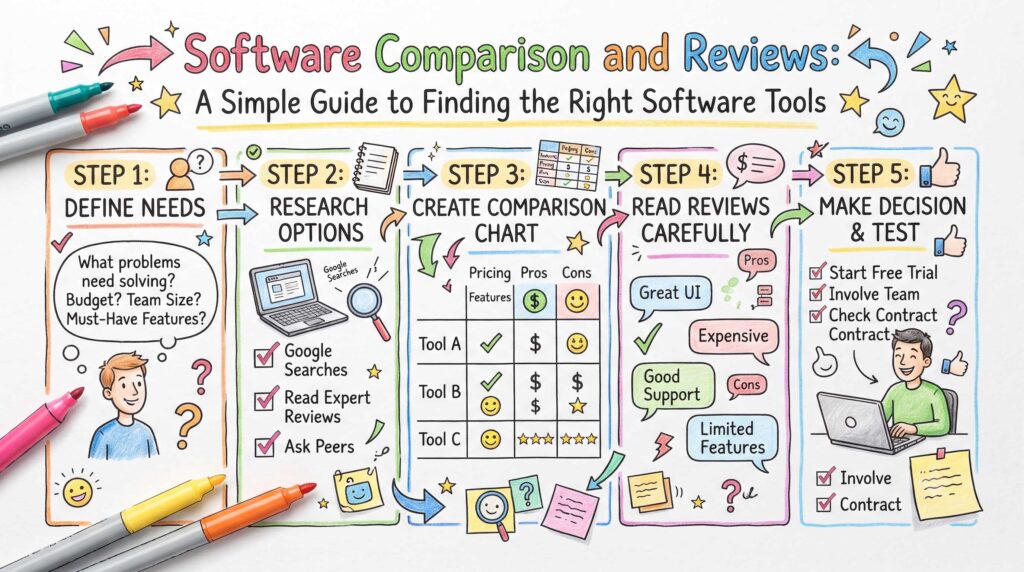
4. Use a Step-by-Step Evaluation Process
A simple evaluation process can keep your research organized.
Define the Problem
Describe the task in simple words. Make the goal specific.
Set Required Features
Separate must-have features from optional ones. This helps you avoid unnecessary features.
Set a Budget
Decide how much you can spend. Include possible extra costs.
Search for Options
Use software directories, reviews, product pages, and technical resources.
Build a Shortlist
Remove products that clearly fail your basic requirements.
Compare the Shortlist
Study features, pricing, integrations, security, and support.
Check Compatibility
Make sure the product works with your current systems.
Review Security and Privacy
Check data collection, storage, access, authentication, retention, and export options.
Test the Product
Use a trial or demo when available. Test real tasks instead of only looking at the interface.
Review Support
Check documentation and support channels.
Calculate the Full Cost
Include users, usage, storage, setup, training, support, and add-ons where relevant.
Read the Contract
Check renewal, cancellation, licensing, and data export terms.
Compare the Results
Match your findings with the original requirements. Then make your decision.
5. A Useful Software Evaluation Framework
This table can help you organize information while researching.
| Factor | What to Examine | Main Question |
|---|---|---|
| Features | Functions and limits | Does it solve the main problem? |
| Pricing | Plans and extra costs | Can we afford the full cost? |
| Usability | Setup and daily use | Can users learn it easily? |
| Integrations | APIs and connections | Will it work with current systems? |
| Security | Access and protection controls | Can we manage the related risks? |
| Privacy | Data collection and storage | How does the product handle our data? |
| Support | Help resources and channels | Can users get help when needed? |
| Scalability | Users and usage | Can it support future needs? |
Use additional criteria when your project has special requirements.
6. What a Software Directory Can Do
A software directory helps users discover products by category. It can bring many types of software into an organized research space.
Categories may include:
- Business software
- Developer tools
- Cloud platforms
- Cybersecurity
- Marketing
- Finance
- HR
- Project management
- AI software
- IT operations
Directories can help users find alternatives. They can also help buyers learn about product features and categories.
However, directory information can change. Companies may update prices, plans, features, or integrations.
Use directories for discovery and early research. Verify important details before purchase.
7. Exploring an AI Tools Directory
AI software covers many different tasks. An AI tools directory can help users discover products based on their needs.
Popular categories may include:
- AI writing
- AI coding
- AI research
- AI image generation
- AI video
- AI marketing
- AI productivity
- AI automation
- AI customer support
- AI data analysis
Each category has different requirements.
A developer may need API access. A writer may need easy controls. A company may need team features and stronger privacy checks.
This makes use case more important than popularity.
8. How to Compare AI Tools
AI tools can produce different results for different tasks. So, users should test the work that matters most.
Start by defining one clear use case. Then compare products using the same basic task.
Look at:
- Main purpose
- AI capabilities
- Output quality
- Ease of use
- Pricing
- Usage limits
- Integrations
- API access
- Data handling
- Privacy
- Security
- Customization
- Team features
- Support
Test Before You Commit
A product description can explain features. It cannot always show how well the product fits your workflow.
Try important tasks during a trial or demo when possible. Keep notes about the results.
This approach can make AI tool comparison more useful.
9. What Makes a Software Tool “Best”?
People often search for the best software tools or best AI tools. However, “best” depends on the buyer.
A small company may want simple software. A large business may need advanced administration.
A developer may care about APIs. A marketing team may need automation. A finance team may focus on reports and controls.
Define Your Own Meaning of “Best”
Consider:
- Team size
- Budget
- Industry
- Skill level
- Required features
- Security needs
- Privacy needs
- Integration needs
- Deployment model
- Support needs
- Future growth
A tool should match your situation. A universal answer may not fit every user.
10. Business Software Needs Extra Checks
Business software often affects many users. It may also connect with important company systems.
Start with the number of users. Then review the pricing model.
Some products charge per user. Others charge based on usage or features.
Next, check team controls. These can include roles, permissions, reports, automation, and administration.
Security and privacy may also need more attention. Your requirements depend on your data and business environment.
Consider the Total Cost
The subscription price may not cover everything.
Additional costs can include:
- Setup
- Training
- Implementation
- Extra users
- Storage
- API usage
- Support
- Premium features
- Add-ons
Include these costs in your business software comparison.
11. Questions to Ask Before Buying
Use this second table during your final product review.
| Buying Area | Questions to Ask | What to Check |
|---|---|---|
| Features | Does it cover our required tasks? | Features and limits |
| Price | What will we spend over time? | Plans and extra charges |
| Security | What controls protect data? | Current security information |
| Privacy | What happens to our information? | Data use and retention |
| Integrations | Does it connect with our tools? | APIs and supported systems |
| Support | How can users get assistance? | Support channels |
| Contracts | What terms apply after purchase? | Renewal and cancellation |
| Future needs | Can the product support growth? | User and usage limits |
Keep these questions during demos and sales discussions.
12. How to Review Independent Software Reviews
Independent software reviews can give buyers useful information outside product marketing.
Still, readers should examine the review method. Look for clear criteria and supporting evidence.
A useful review should discuss both useful functions and limitations. It should not hide important gaps.
Look for Transparent Information
A review becomes more useful when it explains:
- What the reviewer checked
- Which sources they used
- When they checked the product
- What they could verify
- What they could not verify
- Whether commercial relationships exist
This information helps readers understand the review’s context.
13. Software Pricing Needs Careful Research
Software companies use different pricing methods. This makes direct comparisons difficult.
Common pricing models include:
- Monthly plans
- Annual plans
- Per-user pricing
- Usage-based pricing
- Feature-based plans
- Setup fees
- Training costs
- API charges
- Storage charges
- Support fees
- Add-ons
Always check what each plan includes.
A low starting price may not represent your actual cost. Your team may need extra users or features.
Check Current Pricing
Software companies can change their pricing. They can also change plan limits.
When current pricing matters, verify it through recent and reliable sources.
Never guess a price that you cannot confirm.
14. Security and Privacy Should Stay on the List
Security matters whenever software handles information. The level of review should match the type of data involved.
Start by asking what information the product collects.
Then review:
- Data storage
- Access controls
- Authentication
- User permissions
- Data retention
- Data export
- Third-party connections
If your company has special compliance needs, check reliable documentation.
Do not assume that a product meets a specific security requirement without evidence.
15. Check Software Compatibility
Software rarely works alone. Teams often use many products together.
Common connections include:
- CRM systems
- Cloud platforms
- Databases
- Communication tools
- Analytics systems
- Identity platforms
- Project tools
- Developer platforms
- APIs
Check whether the product works with your current technology stack.
Also look at the depth of each integration. One connection may support only simple tasks. Another may support more complex workflows.
If your team needs API access, review the technical documentation carefully.
16. Common Software Buying Mistakes
Choosing Popular Software Without Checking Fit
Popularity can help you discover products. It does not prove that a product fits your needs.
Looking Only at Price
A low price may come with missing features or extra charges.
Ignoring Total Cost
Add users, storage, usage, training, setup, and other likely costs.
Trusting One Review
One review gives one perspective. Compare several sources.
Skipping Security Checks
Review security and privacy before putting important data into a product.
Forgetting Integrations
A product may create manual work if it cannot connect with your existing systems.
Buying Unused Features
Extra features can increase cost and complexity.
Skipping Product Tests
Use trials or demos to test important workflows.
Ignoring Contract Details
Read renewal, cancellation, licensing, and data export terms.
Assuming AI Tools Perform the Same Way
AI results can vary by task. Test important workflows.
Forgetting Support
Check how users can get help during setup and later use.
Ignoring Future Needs
Think about future users, data, workflows, and integrations.
17. How BestAIToolix Can Help With Software Research
BestAIToolix gives users a place to explore software products and technology categories. The platform focuses on software discovery, product information, reviews, rankings, comparison content, and buying guidance.
Users can explore different software areas and research products based on their needs. The platform also supports research around AI tools and business software.
Structured information can make early research easier. Comparison content can also help users identify questions for deeper checking.
However, software information can change. Buyers should verify important details through current sources before making a decision.
BestAIToolix should form one part of a wider research process. Users should also check product documentation and test important workflows.
18. A Simple Research Journey
Use this workflow to organize your software search:
Identify → Explore → Filter → Compare → Verify → Test → Calculate → Review → Choose
Identify
Define the exact problem.
Explore
Find possible products through directories and reviews.
Filter
Remove products that fail your basic requirements.
Compare
Study features, pricing, security, privacy, integrations, and support.
Verify
Check important claims using current sources.
Test
Try real workflows when possible.
Calculate
Estimate the total expected cost.
Review
Compare your results with your original requirements.
Choose
Select the option that fits your needs and resources.
This process keeps software buying focused on evidence.
19. Real Software Research Examples
Small Business Project Research
A small business may need software for tasks and deadlines. The team should define these needs first.
Next, it can compare features, price, usability, and integrations.
The team can test common project tasks during a trial. It should also review user limits and support.
Developer AI Tool Research
A developer may want an AI coding tool. The developer should first define the coding tasks.
Then they can compare output quality, API access, usage limits, privacy, and integrations.
Testing similar tasks can provide useful evidence.
Marketing Automation Research
A marketing team may want to automate repeated tasks. It should first list the workflows it wants to improve.
Then it can compare automation functions, integrations, reports, pricing, and user controls.
A practical test can show whether the product fits the workflow.
IT Software Research
An IT team may need software for a security or infrastructure task. It should first define its technical needs.
Then it can review integrations, access controls, reports, deployment, support, and security documentation.
The team should use criteria that match its own environment.
Frequently Asked Questions
1. What is software comparison?
Software comparison means studying products using selected criteria. Buyers can compare features, pricing, usability, security, privacy, integrations, and support. The criteria should match the buyer’s needs. A useful comparison does not simply count features. It explains how each product may fit a particular task, team, or business environment.
2. Why are software reviews useful?
Software reviews can give buyers more information before they purchase. They may explain features, pricing, setup, limitations, integrations, support, and use cases. Reviews can also highlight areas that need further research. Readers should check the review date, evidence, sources, and commercial disclosures before relying on important claims.
3. How do I begin a software buying process?
Start by defining the problem. Then list the features you need and set a budget. Search directories, reviews, product pages, and technical documents. Create a shortlist and compare important factors. Test suitable products when possible. Finally, check your findings against your original requirements before making a decision.
4. What is the purpose of a software directory?
A software directory helps users discover products in organized categories. It can make early research easier by bringing different products together. Some directories provide product profiles, reviews, comparisons, and buying information. Users should still verify important details because companies can change features, pricing, plans, and integrations.
5. What is an AI tools directory?
An AI tools directory organizes AI products into categories. These categories may include writing, coding, research, images, video, marketing, productivity, automation, and data work. Such directories help users discover possible tools. Users should then compare those tools based on their tasks, budget, privacy needs, integrations, and technical requirements.
6. How should I compare AI tools?
Choose a clear task first. Then compare capabilities, output quality, ease of use, pricing, usage limits, integrations, API access, privacy, security, and customization. Try similar tasks across different tools when possible. AI performance can change between tasks. Practical testing can therefore give you better information than general product claims.
7. What does “best software” mean?
The meaning depends on the buyer. A small team may value low cost and simple setup. A large company may need stronger controls. A developer may need APIs, while a marketing team may need automation. Team size, budget, industry, security, and integrations can all change the decision.
8. What should businesses compare before buying software?
Businesses should compare features, users, pricing, security, privacy, integrations, support, reporting, scalability, and contract terms. They should also estimate total cost. Setup, training, storage, usage, and add-ons can increase expenses. Testing real workflows can help businesses understand how well a product fits their daily operations.
9. How can I assess an independent software review?
Check whether the review explains its criteria and evidence. Look for product testing, documentation, user information, or other sources. A useful review should discuss limitations and separate facts from opinions. Also check commercial disclosures and review dates. These details help readers understand how the reviewer reached its conclusions.
10. What should I test during a software trial?
Test the tasks your team performs regularly. Check setup, important features, integrations, user controls, limits, and ease of use. Also review support options. Keep notes during testing. If you test several products, use similar tasks. This makes the results easier to compare.
11. Why should software buyers calculate total cost?
The advertised subscription may not show the complete expense. Extra users, storage, usage, setup, training, support, API access, and add-ons may increase costs. A total cost estimate gives buyers a clearer budget. It also helps them compare products that use different pricing models.
12. How can a software buying guide help me?
A software buying guide gives you a structured research process. It can explain what to compare and which questions to ask. It can also cover pricing, security, privacy, integrations, and common buying mistakes. A useful guide helps users collect better information without assuming that one product fits everyone.
Final Thoughts
Smart software selection starts with a clear problem. Once you understand that problem, you can focus on the features and services that matter.
Compare price, usability, security, privacy, integrations, scalability, and support. Also check contracts and the full cost before you commit.
Software directories and reviews can help you discover possible solutions. They can also make early research easier. Still, buyers should verify important information with current sources.
AI products need practical testing because their results can vary by task. Business teams should also think about future growth and changing requirements.
BestAIToolix can support software discovery, comparison, reviews, and buying research. Your final choice should match your needs, evidence, budget, and technology environment.
Leave a Reply